Buckeye Herps Blog

A photographic journal of the reptiles and amphibians of Ohio, Michigan and other places interesting wildlife call home.
Showing posts with label ohio. Show all posts

Saturday, July 28, 2012

Ohio 2011 Goals - The results are in!

I made a post two winters ago now discussing goals I had set for myself for 2011 in Ohio and Michigan.  Well I am finally slogging through my data, admittedly during the wrong time of the year, and had finished up the Ohio portion. 


For Ohio 2011.

1. Herp with Carl and Brian a couple solid days this spring.  Check!
2. 50 records. Epic Fail! Although 30+ records was better than my last 2 years combined.
3. Get one of the last remaining animals I have yet to see that occur in Ohio. The ones I have left to see are short-headed garter snake (tried in 2006, 2010), Copperbellied watersnake (tried in 2007), Ouachita Map turtle (tried in 2006) and southern leopard frog. Epic Fail!  I didn't actually try for anything of these, but maybe some day...

My Michigan data for 2011 is wrapping up pretty nicely though.  It was a very good year in the field for me in Michigan and on a couple travels. I hope to be done with it soon.  My Michigan and Ohio 2012 data are looking pretty miserable.  The weather and work has made this season fairly difficult.  I still have August and September to try and salvage some of the paddling stuff, I just need people to paddle with...  Maybe I shouldn't be wasting time in the summer on field notes?

Who wants to come up and paddle Michigan?

BH


Tuesday, February 28, 2012

2nd Ohio Amphibian Research and Conservation Conference

If you have any interest in herps, biology or just enjoy the outdoors, I suggest you check out the 2nd Ohio Amphibian Research and Conservation Conference.  Ohio DNR has been putting on reptile and amphibian conferences every two years now for almost a decade.  They alternate the focus of each conference between reptiles and amphibians, so each topic is approached every four years.  This years event is March 20, 2012 at the ODOT Hilltop Conference Center in Columbus, Ohio. The keynote speaker is Dr. Tyrone Hayes, an amphibian ecologist from UC Berkeley, who will be speaking about amphibian declines.

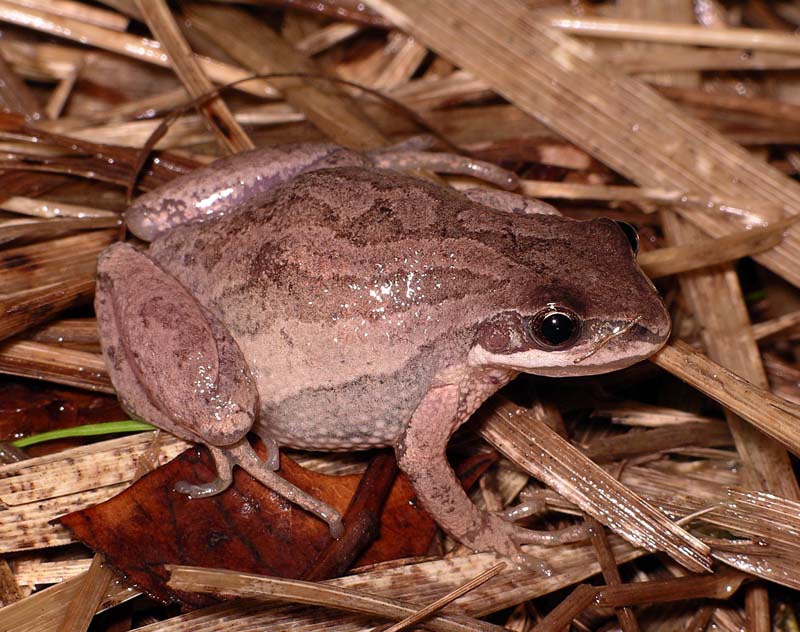
Western Chorus Frog found breeding on March 11, 2006

I have made almost all of these conferences now and they are always full of top notch speakers, fascinating information relevant to Ohio reptiles and amphibians and provide a great opportunity to get together with a group of like minded individuals.  The past few conferences have probably attracted 100+ people in attendance from all walks of life and level of interest.  These conferences are pretty laid back, and provide a wonderful venue to celebrate herps and bring in the new field season.

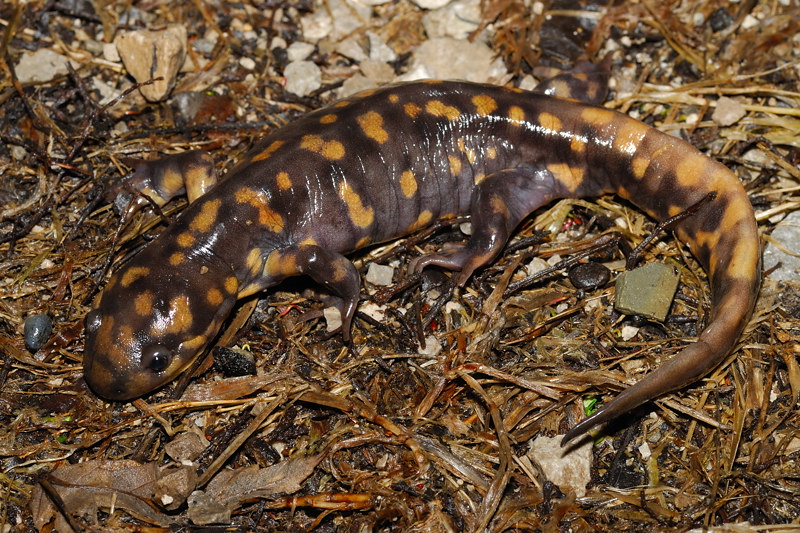
Tiger Salamander roadcruised on March 15, 2008

The conferences are centrally located in Columbus Ohio.  You can obtain more information about registration (late now), location and scheduled speakers here.  Another selling point is that the past 2 or even 3 conferences I have attended were blessed with rain.  I have been able to get some early spring amphibian migrations in on almost every occasion!

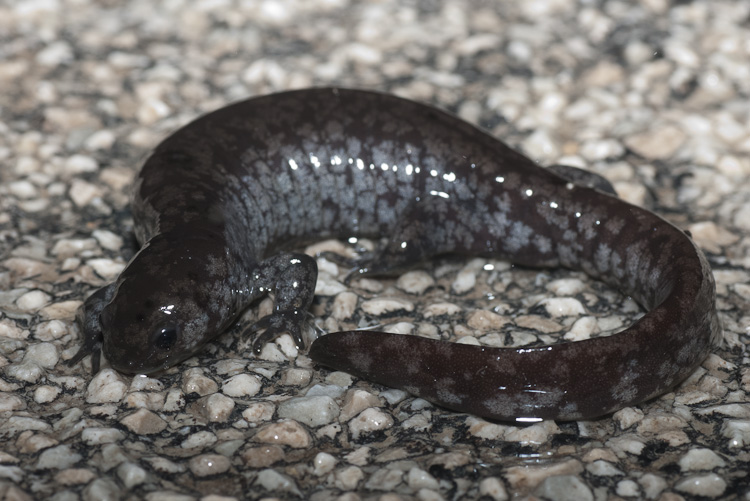
Smallmouth Salamander roadcruised on March 13, 2010

Thursday, September 22, 2011

Ohio Snake Identification - Venomous or Not?

I am contacted by many people each year asking for help to identify snakes they find in their yard.  Many are just curious as to what animals call their yard home, or what they saw while camping.  I would be lying if I didn't mention that most just really want to know if they are in danger and often adopt the approach of "shovel first, questions later".  Is it "poisonous" or venomous is more often than not top of the list of questions they ask.  My hope is that this will address some of those questions and help provide a place for others to ask their questions and contact me more easily if needed.

If you don't care if it is venomous, still feel free to leave comments or contact me as directed below.  You may look at the pictures under the Reptiles tab to try and figure out what snake you have seen.

Ohio Venomous Snakes

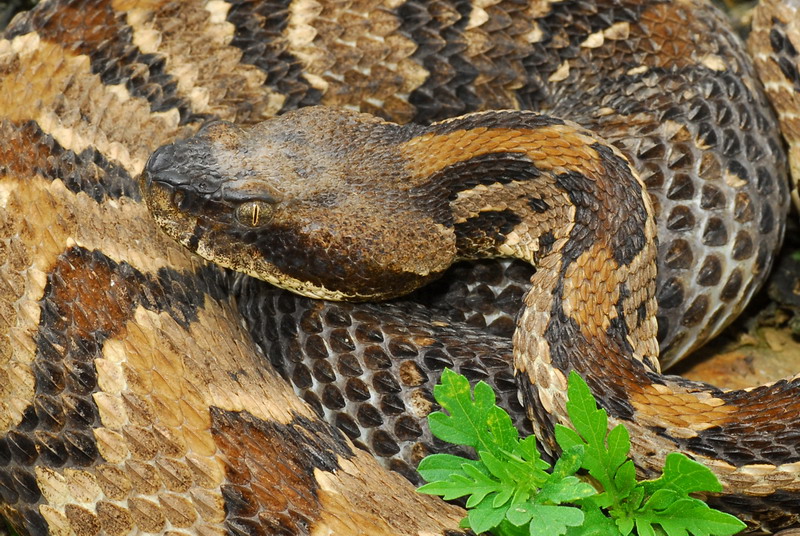
Ohio has three species of venomous snake.  That is three species out of the twenty five snake species that call Ohio home.  They are the eastern massasauga rattlesnake (Sistrurus catenatus), the northern copperhead (Agkistrodon contortix) and the timber rattlesnake (Crotalus horridus).  Unfortunately, due to habitat loss, road mortality and persecution, both the timber rattlesnake and massasauaga rattlesnake are listed as state endangered species and can only be found in very specific locations in the state.  It is highly unlikely that most Ohioans will ever encounter these animals.

Here are some general rules for identification when you are looking at a snake in front of you.  These rules only apply to Ohio and snakes that can be found in the wild.


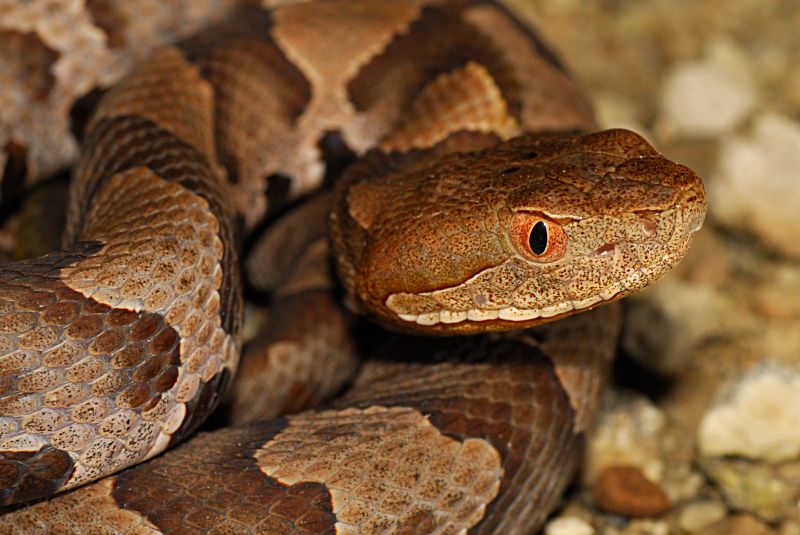
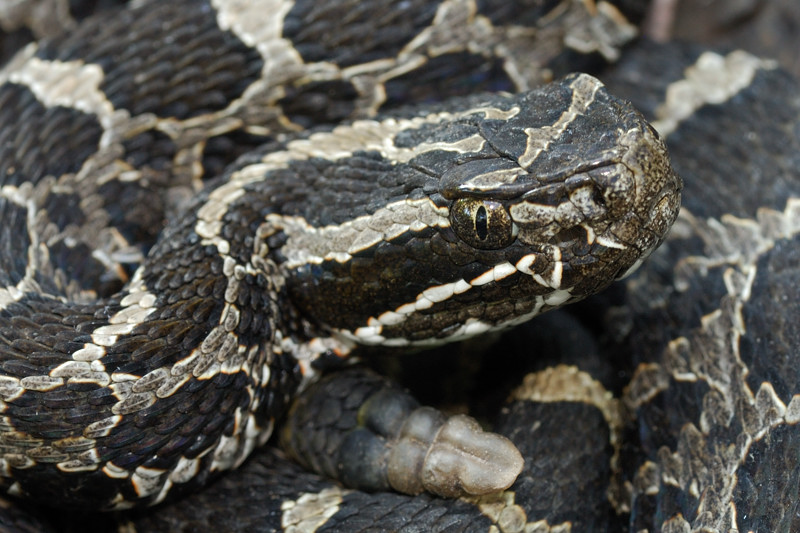
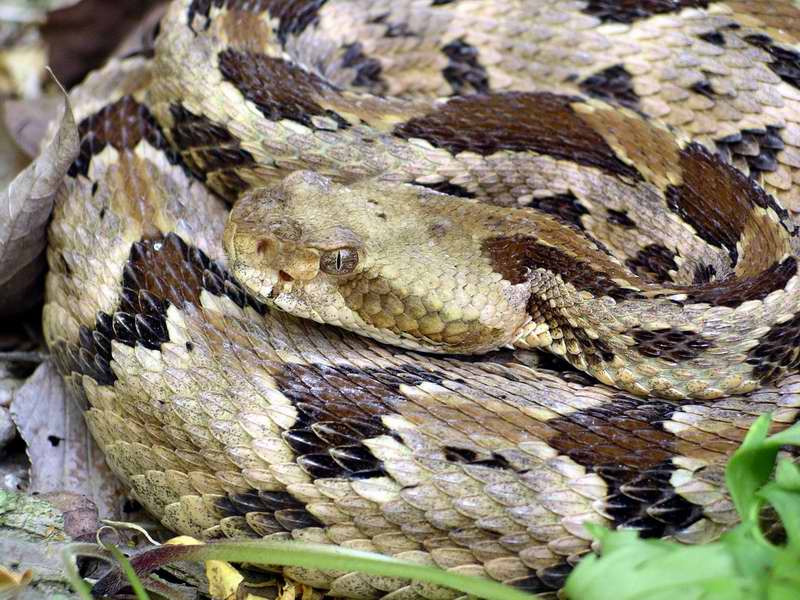
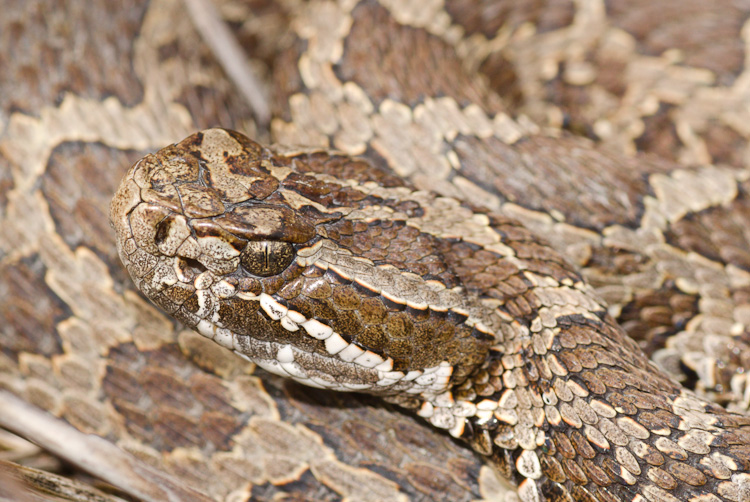
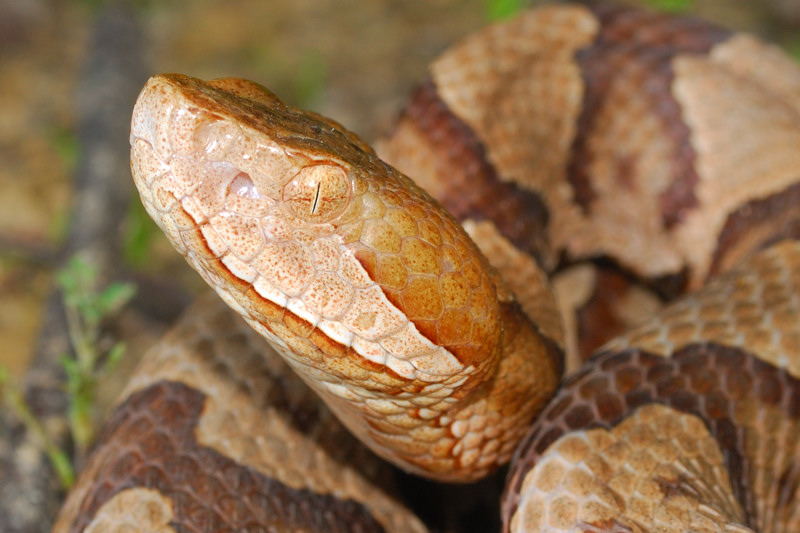
1. Vertical pupil vs round pupil - All of Ohio's venomous snakes have vertical, cat-like, pupils.  Ohio's nonvenomous snakes do not.  Again, outside of Ohio, there are snakes that do not follow these rules.  Here are pictures of all three of Ohio's venomous snakes that clearly depict the vertical pupil.

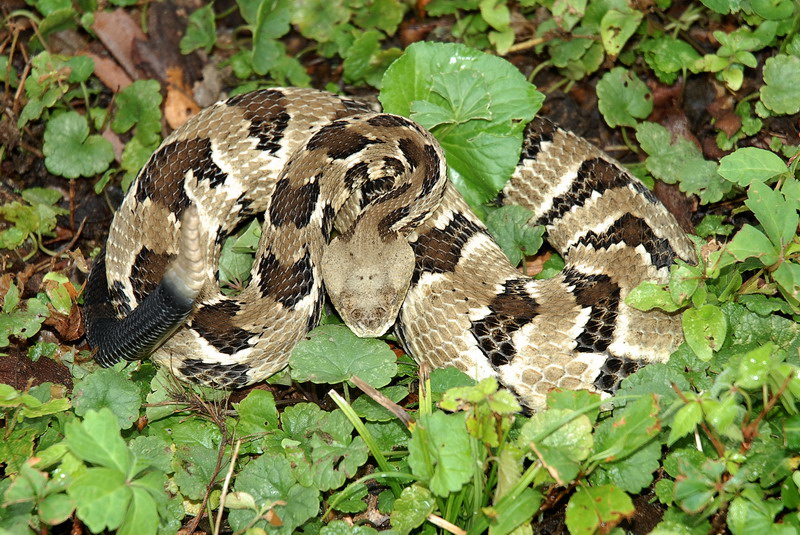
Timber Rattlesnake

Copperhead

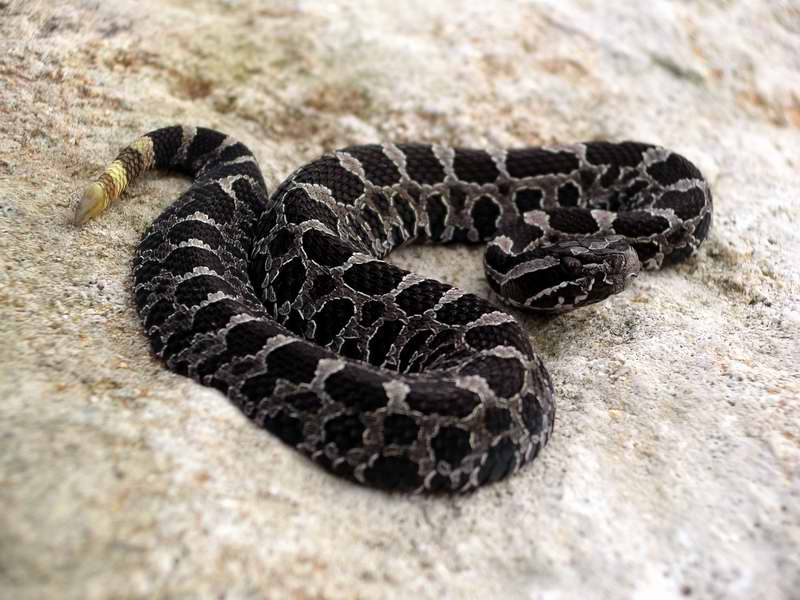
Massasauga Rattlesnake
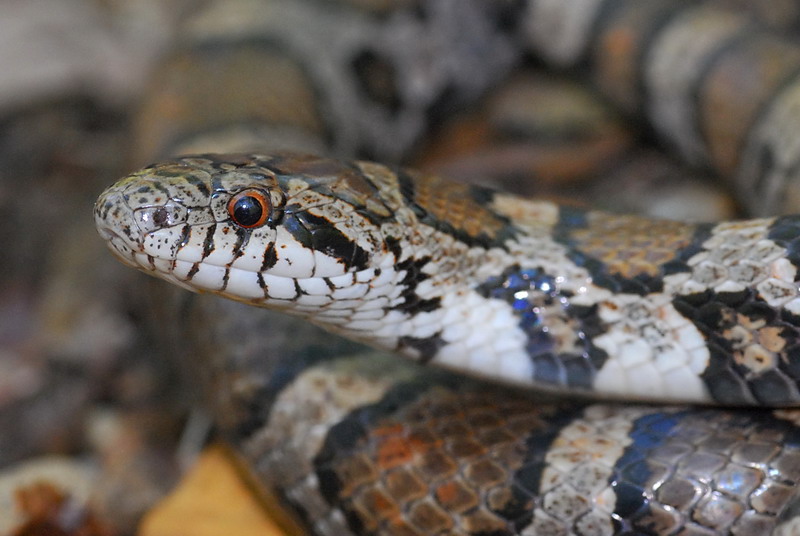
And a nonvenomous snake, the eastern milksnake.  This snake is commonly confused for a copperhead or massasauga rattlesnake.


2.  Presence of a facial pit - All of Ohio's venomous snakes are pitvipers.  They have a heat-seeking pit that helps them localize their prey.  The are ambush predators, and will sit and wait for a small rodent to run by, sometimes at night, and their pits help them hunt.  Ohio's nonvenomous snakes do not have these heat-seeking pits.

Timber Rattlesnake - pit is easily visible to the left and below the eye, just like in the above drawing.
Massasauga Rattlesnake
Copperhead
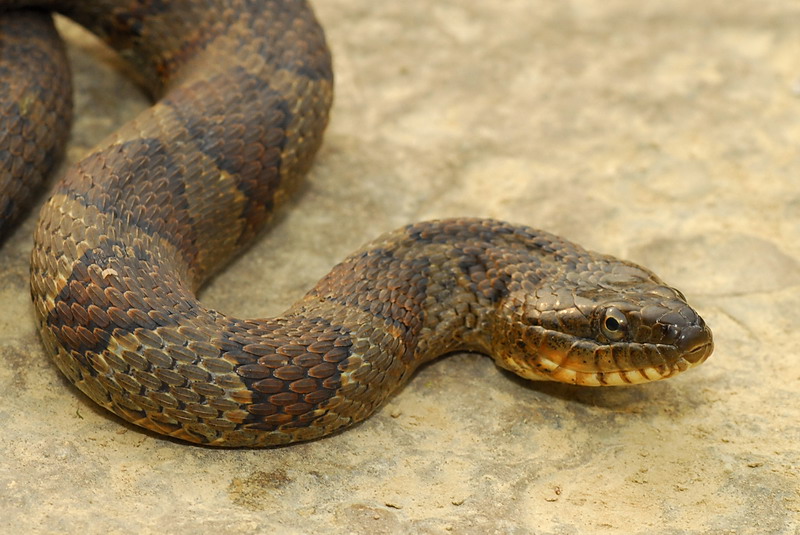
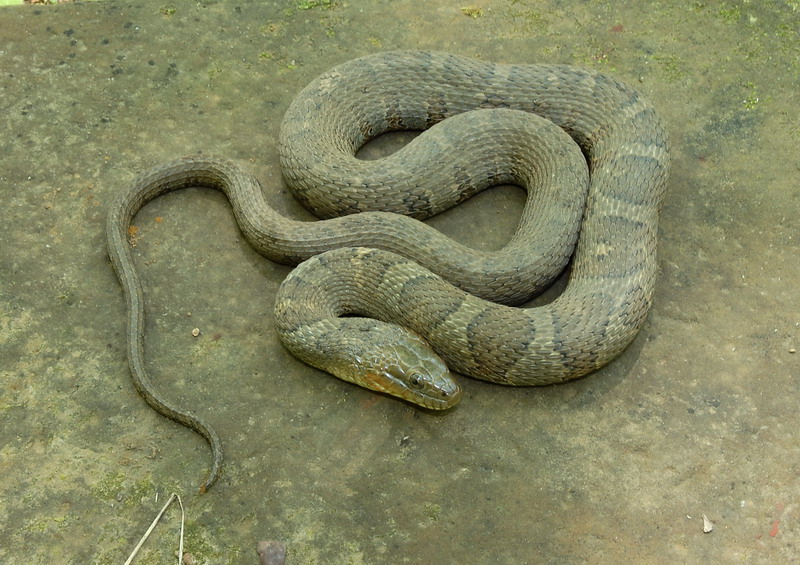
Northern Watersnake, nonvenomous - note the lack of a vertical pupil or pit.  These are often confused for copperheads.

3. Divided anal plate and double tail ventral scales after the cloaca vs single anal plate and tail ventral scales after the cloaca. In normal terms, the nonvenomous snakes have a split or divided scale that covers their cloaca.  The cloaca is the opening (butt) of the snake where feces (poop) is excreted.  The scales after the anal scale will also be divided or doubled. Venomous snakes of Ohio have a single anal scale and single scales after.  I will obtain pictures of anal scales soon, but please refer to the above figure.

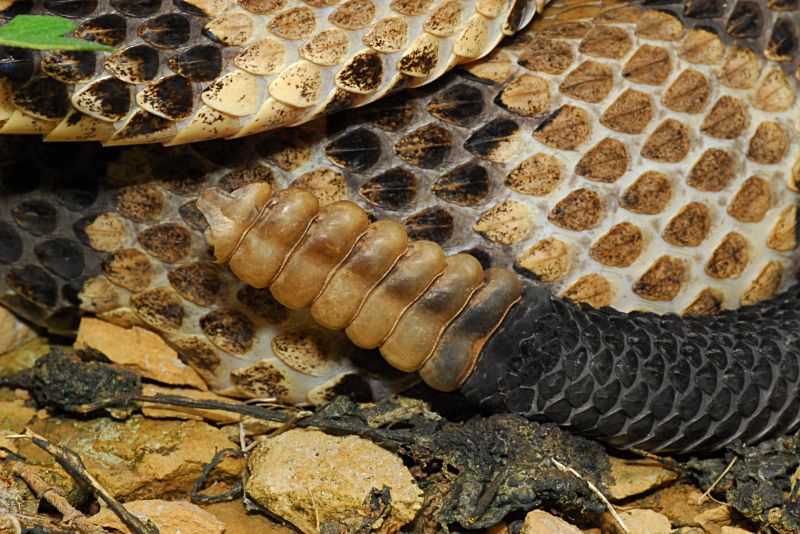
4. Presence of rattle - Two of Ohio's three venomous snakes are rattlesnakes and have a rattle that produces a loud noise.  I will be sure to record one soon as well for you to listen to.  This is not as easy as it seems, as most other nonvenomous snakes will rattle their tails in leaves to mimic the rattling sound.  Also, their copperhead will also rattle it's tail, although it does not have a rattle.  Finally, young rattlesnakes just have one segment of rattle, or a button, and their tails will not make noise.  If you see a rattle, or hear a rattle, it is best to just walk away.

Timber Rattlesnake rattle
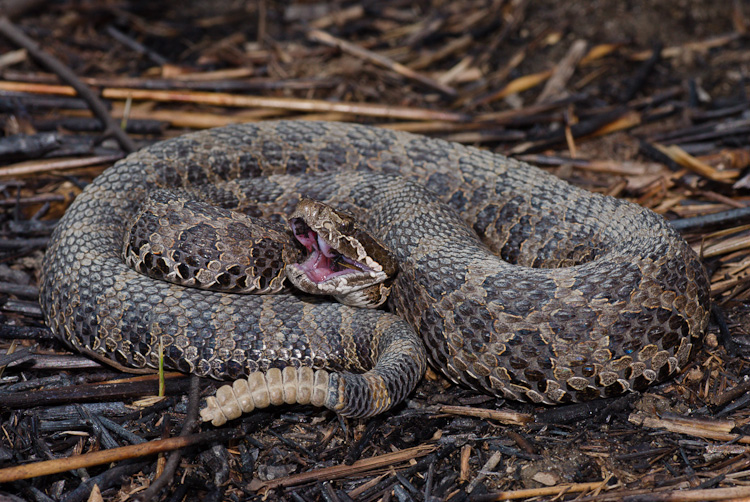
Massasauga Rattlesnake, with large rattle, saying "Stay Away"
Massasauga Rattlesnake, neonate or baby, with single button
 5.  Triangular head vs Rounded head - It is true venomous snakes often will have a triangular head.  Many nonvenomous snakes will flatten their neck and change their shape slightly to look more triangular.

Timber Rattlesnake - displaying the triangular head shape
Northern Watersnake with a fairly triangular head
Eastern Hognose Snake showing a triangular head
Remember, most of these snakes have specific habitat preferences and needs.  They are not found all over the state.  Just because a snake lives in Ohio, does not mean it lives in your area as well.  If you draw a line from Cincinnati to Cleveland, a very general rule is that Massasauga Rattlesnakes occur sporadically in the NW half of the state, while Timber Rattlesnakes and Copperheads occur only in the rocky, hilly region in the SE half of the state.

Now, you are probably reading this and saying "BuckeyeHerper, you are crazy if I am ever going to be close enough to a snake to look it in the eye, or lift it's tail to check the butt."  I agree completely, but I do not feel this is a reason to kill the snake. If you aren't sure, just keep a safe distance and leave the snake alone.  Luckily snakes are not as aggressive as people typically think they are.  They will run more often than not.  If they do happen to stand their ground, you can very easily walk away or around them without any worry.  If you are comfortable, everyone has a digital camera or cell phone these days, and it is easy to take a quick picture from a safe distance.  You can then compare your picture with pictures on this and other websites, or email it to me or others for assistance.

Again, if you aren't sure, just keep your distance.  These snakes are very rarely encountered, and chances are you have just found one of the more common nonvenomous snakes.  Despite what you might have heard, Ohio also does not have any cottonmouth, or water moccasins.  The closest populations are hundreds of miles away.

If you have any further questions, or want to share pictures or stories, please feel free to leave a comment below or email me at foltjr AT gmail.com .

Wednesday, September 15, 2010

Back in the States, Back in the Field

I arrived back in the US on August 20 feeling tired but excited to be back in the States. The heatwave from the summer rendered the Midwest bone dry, but with a little work and luck I figured we could turn up a few animals. After being home for only a day or two, my Dad and I made a roadtrip up to Michigan to visit the Buckeyeherper and catch a baseball game. Naturally, we scheduled in some field time. We invited my brother David along, but he declined, saying that "we never find anything" when he comes out into the field with us. His loss, our gain, I suppose....

We checked out a neat fen in southeastern Michigan. The area supports some interesting fauna, including a few species of turtles, snakes, and frogs. Bob particularly enjoyed the pitcher plants and sundews, when he was finally able to spot them. Of course, Cid and Joy tagged along for the trip, who are always eager to get out into the field. After investigating the area for about an hour, Cid, Joy, and I hiked right past this little 1 year old snake. Fortunately, the more experienced Michigan herper made the spot:


Eastern massasauga rattlesnake (Sistrurus catenatus) found on August 22, 2010 at 6:35 PM.
This was Bob's first ever swamp rattler, and only my second, so suffice to say we were quite pleased. Too bad Dave wasn't along for the fun......

About a week later, I found myself back down in Athens, Ohio, gearing up for the start of another school year. On the August 28, the weather was looking prime to see pitvipers, so a buddy and I went down to a familiar hiking and flipping area to see what we could turn up. Unfortunately, the first find of the day was absolutely devastating. I've had zero luck over the years with one of Ohio's more interesting snakes, the Eastern hognose snake (Heterodon platyrhinos), and it was certainly in the back of my mind when we set out that morning. Imagine my dismay when we found one on the road around noon... but dead:


Bummer. We proceeded on to check a few flip spots before embarking on our hike. The first thing flipped is one of the usual suspects for southern Ohio, the Northern ringneck snake (Diadophis punctatus):
On our hike, we saw a few lizard species. Unfortunately, the skinks were too quick for us to bring in hand. However, we did successfully photograph an Eastern fence lizard (Sceloporus undulatus) and an Eastern box turtle (Terrapene carolina):

Our luck was pretty raw on the hike. We didn't see any vipers and both of us found our pants covered in hundreds of "micro" ticks: minuscule ticks less than 1 mm in diameter (I literally scraped hundreds off my ankles that night. Disgusting.).

We checked a few other spots. A Northern black racer (Coluber constrictor) was too quick for us and bolted away. However, we flipped a nice Black rat snake (Scotophis spiloides), which promptly tagged Carl on the cheek:


Ouch. I also photographed this pretty snake:


Eastern milk snake (Lampropeltis triangulum).

After grabbing a bite to eat and hitting a few more spots as it got dark, we decided to roadcruise a few "new" roads that haven't been too successful in the past. It was a cooler night, with temperatures down into the 70s. At 8:30, right as it was getting dark, we were pleased to find this:

A Northern copperhead (Agkistrodon contortrix), in situ. The rest of the night was fairly eventful, as we stopped for two more copperheads at 9:03 and 9:45. At around 10:30, we headed home, decently pleased with the day's activities.

Three snake night... not bad!

Unfortunately, I'm currently super busy with club soccer to spend much time in the field in search of herps. However, I did participate in a field trip for my Ornithology class on Saturday September 11. At three different localities, we saw over twenty species of birds, including a few lifers. First, at 7:15 AM, we saw a few local vultures hanging out on tops of houses along Grosvenor Road in Athens, OH:
-10+ Black vultures (Coragyps atratus) (lifer)
-2 Turkey vultures (Carthartes aura)

Next, we stopped off highway 686 along the Hocking River, down beneath the ridges. There we observed:
-2 Osprey (Pandion haliaetus) (lifer)
-American crows (Corvus brachyrhynchos)
-1 Belted kingfisher (Megaceryle alcyon)
-Mourning doves (Zenaida macroura)
-
Killdeer (Charadrius vociferus)
-
1 Pileated woodpecker (Dryocopus pileatus)
-1 Canada goose (Branta canadensis)

From around 8:00 AM to 10:00 AM, we hiked around the Ridges, an elevated ridgetop area that is a part of Ohio University's campus. There we observed:
-American robins (Turdus migratorius)
-
1 Cedar waxwing (Bombycilla cedrorum) (lifer) "the bird that rocks," according to our prof
-1 Yellow-throated vireo (Vireo flavifrons) (lifer)
-1 Red-bellied woodpecker (Melanerpes carolinus)
-1 Downey woodpecker (Picoides pubescens)
-
1 Carolina wren (Thryothorus ludovicianus)
-
1 Caroline chickadee (Poecile carolinensis) (lifer)
-Blue jays (Cyanocitta cristata)
-Northern cardinals (Cardinalis cardinalis)

A few other species were seen by people in the group. However, I only listed the birds above that I was able to visually ID.

Hoping to get back out into the field soon....

Brian


Monday, March 15, 2010

Another One Bites The Dust

I attended the 2nd Ohio Reptile Conference over the weekend. It was once again a truly enjoyable experience. There is a conference held in Columbus every two years, and the subject rotates between Reptiles and Amphibians. I missed the very first amphibian conference 6 years ago but have made the 3 conferences since. They always line up some wonderful speakers, you learn a ton, and it's a great opportunity to catch up with old friends.

Another bonus is the conference always falls around midMarch. This has coincided with spring rains the last 2 times, and it seemed that this year would be no different. I don't always get up into that part of the state during the spring, so it provides a welcome excuse to check out new territory.

My brother Brian rode up from Ohio with Carl, and my dad made the trip down from Cleveland. As is becoming a tradition, after the conference we grabbed a bite to eat and waited for night to fall. We had a few friends join us, some new, some old, so dinner was a great prequel for the night to come.

Failure.

The rains long passed over Columbus, and despite some initial promising radar reports, no further rain hit. We saw a few Rana pipiens, and got soaked trying to catch calling Pseudacris triseriata and P. crucifer. Alas, the salamanders weren't moving.

It was getting late, and all of the group had long drives (mine was 4.5 hours) so we decided to call it in. As I headed north, drizzle started to wet the windshield and finally some good rains hit north of Columbus. I threw caution into the wind, and drove back roads most of the way home. I was rewarded with my first Ohio Ambystoma texanum.

Smallmouth Salamander


This is a common salamander in the right part of the state. Laughably I had never seen one, and really never focused on looking for one before. I had wandered into range many times, but never made a true effort.

And thus, the title of the post. Excluding a few species that have questionable history/range in Ohio (Wehrle's salamander, wood turtle, coal skink) I have only 4 more species to find in Ohio borders. This used to be a fairly important goal for me, but has very much fallen by the wayside in the last 2-3 years. In truth, I haven't looked for any of the remaining species in about that long. Anyway, it is nice to knock one off the list, and I have to say I was really hoping it would happen last night with the texanum. Maybe someday I will get around to the remaining suspects: copperbelly watersnake, short-headed gartersnake, Ouachita map turtle and southern leopard frog.

The night also produced some western chorus frogs, and a jefferson salamander. I rolled into Detroit after 5am thanks to the time change. Today was rough needless to say, but it was all worth it.


Hurrah for spring, and happy hunting everyone. Winter had gone on far too long...

BH