Buckeye Herps Blog

A photographic journal of the reptiles and amphibians of Ohio, Michigan and other places interesting wildlife call home.
Showing posts with label Tiger Salamander. Show all posts

Saturday, April 5, 2014

Spring? The salamanders are trying!

With a few days in the mid 40s and 50s the last couple of weeks, we are finally almost defrosted here in SE Michigan. I spent some time scouting vernal pools for my goal of a Macomb Co tiger salamander. All week, despite the warm temperatures, I was hiking on inches of ice, and a few of the vernal pools were over half frozen and still covered with snow. Unfortunately, it hasn't rained much at night, and when it has, it has still been really cold. Well it rained most of the day on April 4th during the day, with temps in the mid40s. Despite knowing the pools were still frozen, I decided to try them at night anyway.

I met up with another local (hardcore baby, hardcore) herper Chris B. He was thankfully up for being a good sport and trying something new with me. We headed out to the place I had scouted shortly after dark. It was a cold and very windy walk to the woods. I asked him how warm it was - the phone confirmed it was below 40 here. Still hopeful and desperate, we continued on. It had been a very long and cold winter after all.

Some phone pics of the area from scouting this week.


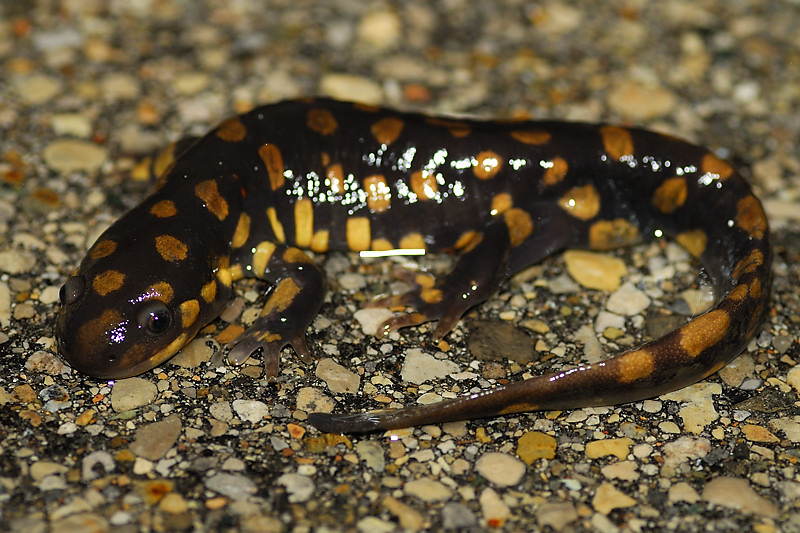
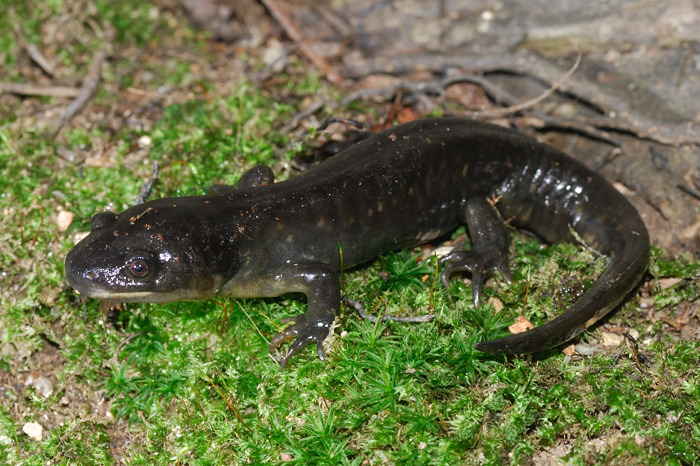
We walked up to the first of four vernals and were greeted with silence. Well the frogs are smarter than we are. I took a few steps out, and looked down in the beam of my flashlight to see my specific target. An eastern tiger salamander from Macomb Co. Well, that was easy.


We made a few jokes about how easy that was. Chris even joked that if he didn't photograph it we wouldn't see any more. I'll save you all the suspense, it was our only tiger of the night. We searched that pool and 3 others extremely hard, fueled by early success. Within a few minutes it started to "precipitate", by which I mean a freezing cold sleet that later turned to snow. Awesome. We searched the four ponds, two of which were more wooded and, oddly were completely clear of snow and ice. The other two were still very frozen. The water temperature couldn't have been much above freezing. We hiked icy trails, and trudged through ice in the ponds, leaving trails like Antarctic sea vessels. We finished with six salamanders. One tiger, four bluespots, and a small newt. All but the last bluespot were found in the icy/frozen ponds. The last bluespot was actually moving through the leaf litter a ways from any water. All that we checked were males, we didn't disturb a couple of them (Edit: I was reminded by Chris that the salamander pictured below was in fact a female, which makes sense, as it looks like a unisexual from the laterale complex, which are typically all females)


I had flipped a spotted salamander at this location last year, so they are likely still smart enough to remain below ground. We saw no spermatophores or egg masses. I bet this place is just awesome under good conditions.

It will remain a night for the memories though. Can't say I enjoyed the cold, it took me a few hours to defrost at home. May the warmer rains come soon. Thanks to Chris for joining me and being a good sport.

These actually were not my first Michigan herps of the spring. More on that when I can get through pictures.

Thursday, April 26, 2012

Spring Cruising

In mid March we had a few large storms blow through with temperatures holding in the 40s and 50s.  I had been watching the approaching storm on the radar all day, and planned my route.  I started driving about 1.5 hours prior to dusk, as it wasn't raining yet and the rains were slowly moving west to east torward me.  I figured I would meet the rains west of here, just as dark was falling.  I knew the salamanders would be out, and I wanted to maximize my time on the road.

I loaded up the car with snacks, camera gear, rain gear and my dogs as company.  It was going to be a long night, so they each had some comfortable beds, water and plenty of toys.  We were off.

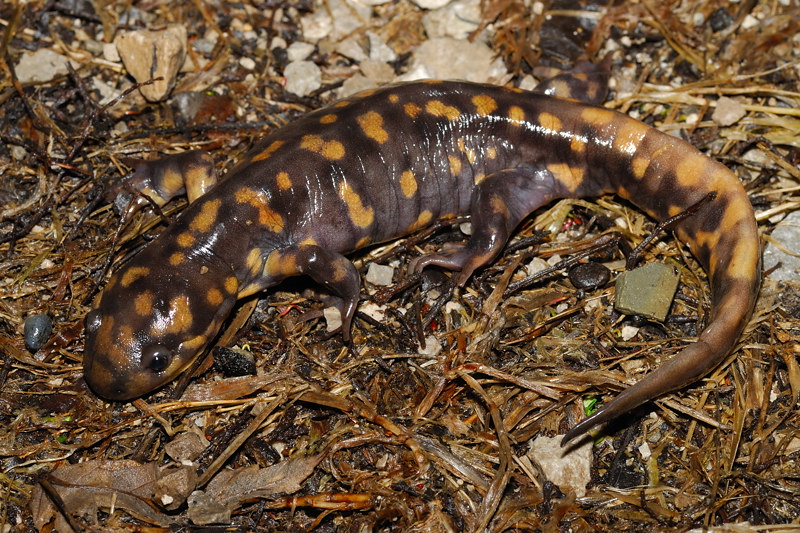
I drove about 1.5 hours and just as dusk hit, the rain started to come.  I had planned well.  Immediately frogs were noticed to be moving across the road.  Within about 15 minutes, I had my first salamander of the night, an eastern tiger salamander.  Unfortunately, he wasn't the most cooperative for pictures, but I saw many more.

Wood Frogs Rana sylvatica were abundant.


Unfortunately, DORs (dead on road, as opposed to AORs, active on road) were also abundant.  I usually photograph these as well, no matter how gruesome.  They can still serve a purpose and get recorded in online databases.

Tiger DOR


Blue Spotted Salamanders Ambystoma laterale (or their polyploid brethren) were also extremely abundant, and would be the most common salamander observed.  They were mostly found on the forested back roads, or remote paved roads, and usually only during the rain.  I would end up seeing 25+ of these throughout the night.


The tiger salamanders, Ambystoma tigrinum, were typically found crossing the busier paved roads running through farm land and other slightly developed areas.  I found none of these crossing the dirt roads or roads running through the woods.


Oddly enough, the nice vernal pool I checked out with Nick Scobel et al. that was in the forest, was full of tigers.  We saw none of them on the roads leading in or away, despite multiple passes, but the pool had to many to count tiger salamanders swimming around.

Tiger Salamander Ambystoma tigrinum


No blue spots were observed in the pool, but we spotted one lonely individual crossing the road while we were shooting the tiger.


A couple other nice vernal pools were checked without finding any salamanders.  I split away from the others again and hit the roads.  The rain had mostly stopped, as it had passed us by now, but I new the salamanders would still be moving a little.


In the end, I saw 25+ blue spots, and 5 or 6 AOR tigers.  There were countless tigers in the vernal pool.  Many more of each species were observed DOR.  I crossed through 3-4 counties, and was in the car for 11 hours.  I pulled into my driveway at 530 am feeling pleased with my efforts.  One continued frustration was my lack of Spotted Salamanders, Ambystoma maculatum.  I have yet to see one of these common salamanders in Michigan, and despite all the miles covered and all the hours cruising, none were viewed crossing the road.  They were typically the most numerous salamander viewed when I when cruising in Ohio.  Another mystery for another day...

Spring has sprung!

BH

Friday, August 21, 2009

LosTigres!

Since relocating to Michigan, I miss some of my favorite Ohio species and the much greater herp diversity. The wolverine state isn't a total crap show though, as some animals are actually a little bit more commonly seen up here. People say it is one of the last massasauga strongholds, but I still haven't totally cracked that nut yet. No today we are talking about another awesome beastie - the tiger salamander, Ambystoma tigrinum.


My first run in with these behemioths was actually when I was living in the suberbs of Detroit while growing up. We had a small woods a little down the road behind our subdivision that harbored redback and blue spotted salamanders in decent numbers. My brothers and I found them with ease back in the day and enjoyed looking them up in our fathers worn Peterson Guide. Although I can't recall ever actually flipped a tiger salamander, our close friends frequently found them in the pool and window wells every spring/summer. One year, we kept one, and my younger brother even took it in to school were it thrived and was extremely well taken care of.

Unfortunately, the places I lived in the southern and eastern parts of Ohio weren't really known to harbor tiger salamanders. I always hoped I could turn one up in south central Ohio, or along the Ohio river floodplain. It sure is not out of the question, and Carl Brune's spectactular Ambystoma find this year further reiterates the fact that we learn new things about these animals every day. Even Cincinnati was known to have a few older records, but alas, it was not to be for me. I traveled north a few times and was able to observe 3 tigers at 2 different locations during my time in Ohio. Usually this required some extensive planning, epic rain dances, a good deal of gas and even more luck. If you can find some of the right areas, they can actually be fairly common at the right times of the year.

Amystoma tigrinum are monsters. They can reach 12 inches, but most adults fall in the 7-9 inch range. This is still a good deal larger than most other Ambystomids, and they tend to run a bit thicker too. These guys are the Barry Bonds of the salamander world. They also have monstrous heads, far bigger in proportion to the rest of their body when compaired to their brethren. The larva also tend to get quite large, and some populations have been known to retain their larval form, although this is much more common in the west.

In Ohio, tigers are primarily found in the glaciated region of the state. You can draw a rough line from Cincinnati to Cleveland. I have had most luck around the Dayton and Columbus areas. In Michigan they tend to be much more commonly found, and range throughout most of the lower peninsula.


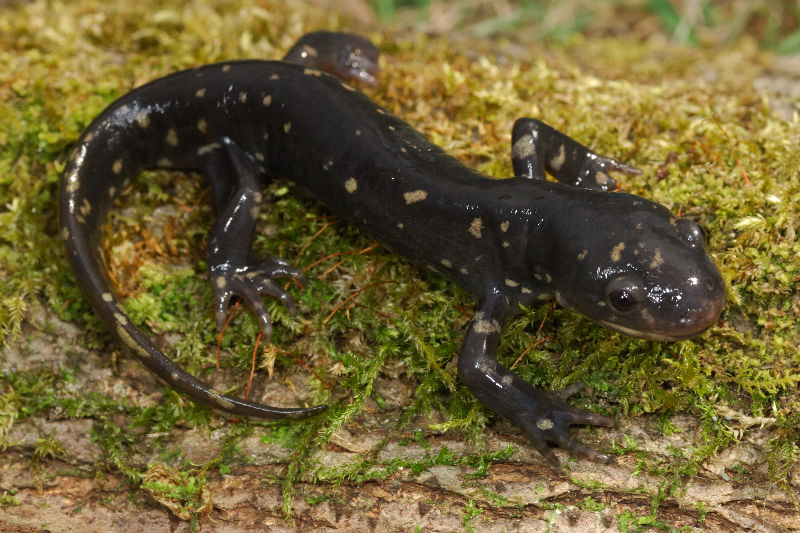
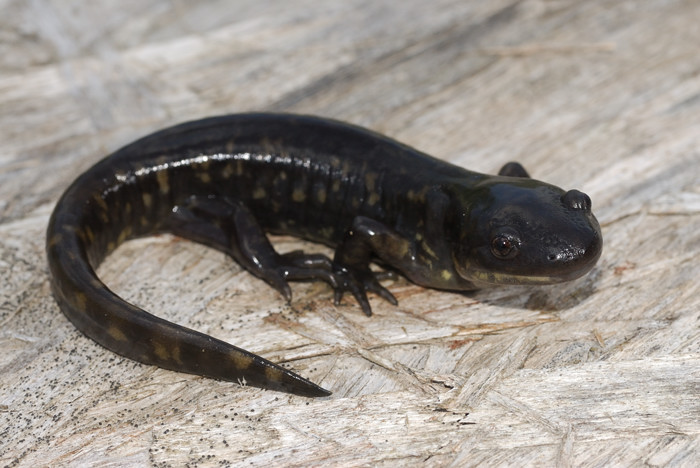
I have yet to find any Michgan monsters, but I have seen more tigers this season alone than I ever did during my years in Ohio. Admittedly, much of this is luck. I didn't see any last season, (but I was still in Ohio during the spring) and I just found 3 at one location last week. Interestingly, all of the ones I have seen have had very dark coloration and minimal amounts of spotting, suggestive of faily young animals. All three found last week were like this, but they were a decent 5-6 inches long.


If you play your cards right and get out to the fields in the spring or fall during some nice night time rains, you might really hit it big and see a few of these in a night. If not, keep checking your neighbors pool because you never know when a monster might turn up.