The Niles Daily Star, the local newspaper for Niles, Michigan, just reported a story of a rattlesnake being found on the property of one of the rural residents of the area. The story is full of wonderful information regarding the Eastern Massasauga Rattlesnake, Sistrurus catenatus, and the snake has not been killed and will most likely be released back to where it was found. These are all great things, except the snake is really an Eastern Hognose Snake, Heterodon platirhinos. Please read the article that I have linked. I hope they don't mind if I share their picture as well?
http://www.nilesstar.com/2011/09/26/rattlers-in-niles/
 |
| Niles Daily Star Photo/Katie Rohman |
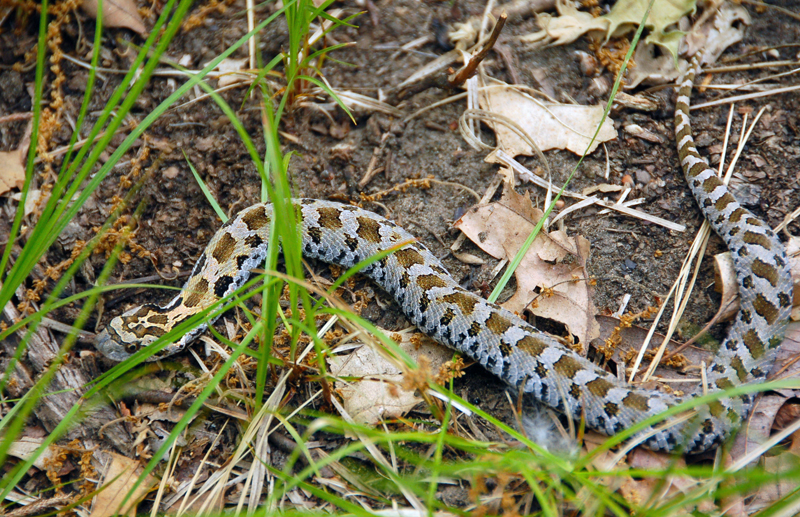
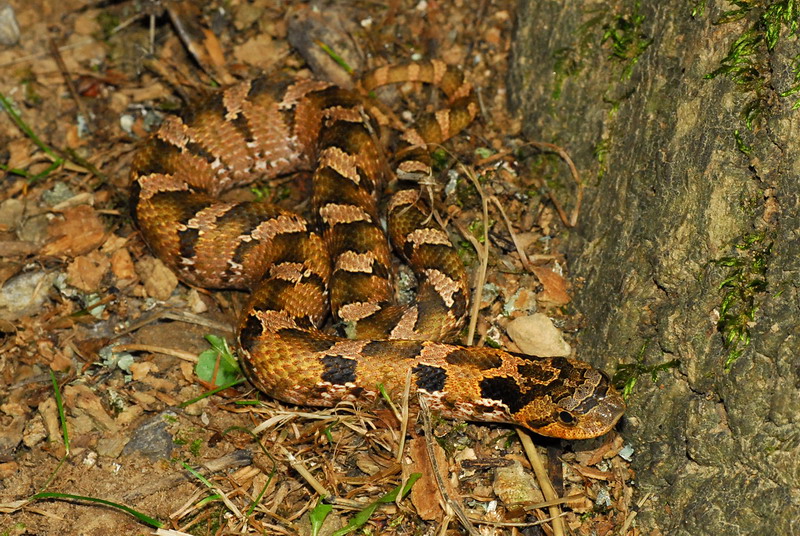
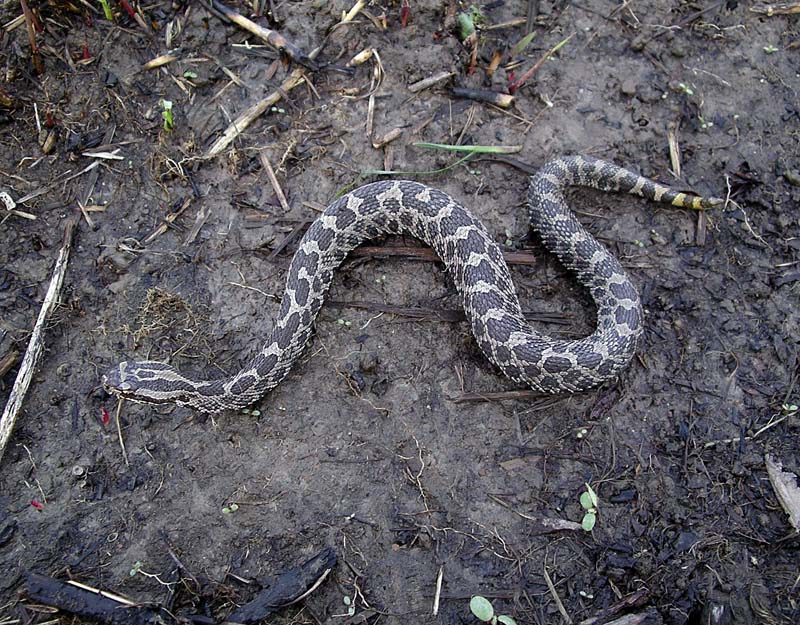
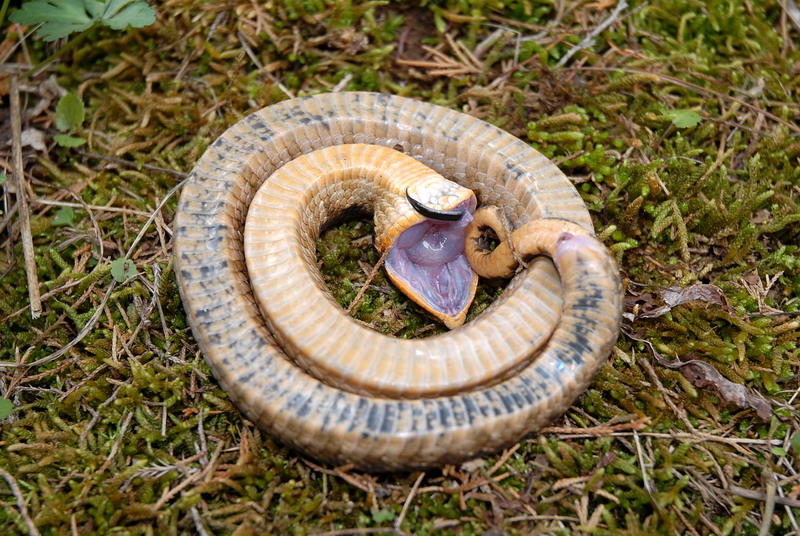
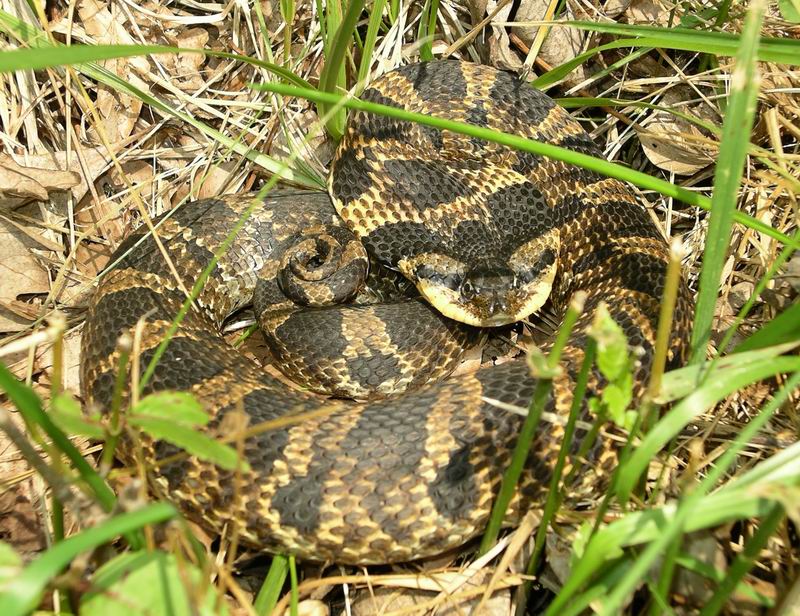
Hognose snakes are often confused for massasauga rattlesnakes as they can have similar size and patterns. Although this picture hides the best characteristics with a blurry head and a wood chip over the tail, it is clearly a hognose snake. Massasaugas are typically very young at this size, and have an overall thinner body. The have a well defined neck that tapers down after the head, unlike the "neckless" hognose. Young massasauagas also typically have much more black/white/grey coloration at this age with stark contrast. The tans and creams of this snake would not be seen in massasaugas. If you look closely at the blurry head, you can make out the blunt, short head and upturned nose of a hognose snake. Hognoses are toad specialists and live in sandy environments where they can dig around for their prety.
 |
| This midsized hognose from a few years ago looks similar to the snake from Niles. |
 |
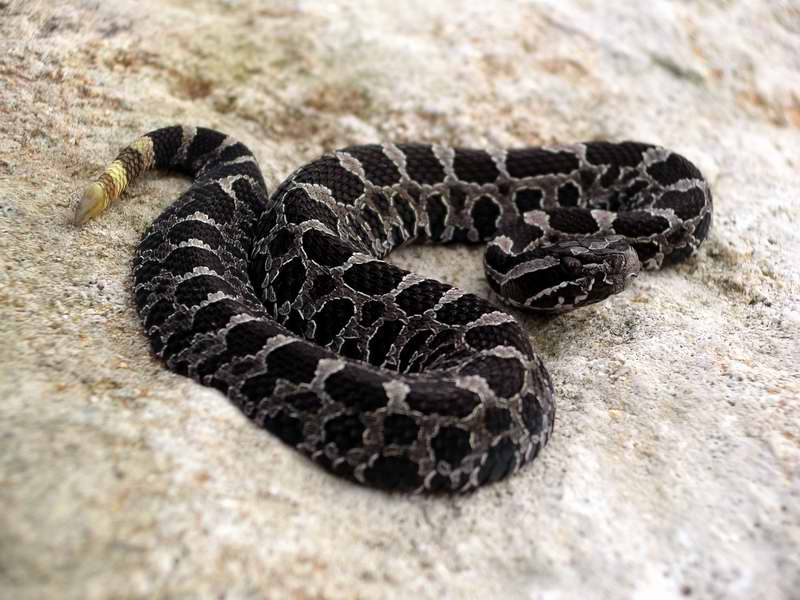
| This is a young eastern massasuaga rattlesnake - note the yellow tail, one segment button of the rattle, contrasting tones and narrow neck. |
 |
| This is a young eastern massasuaga rattlesnake - note the yellow tail,
one segment button of the rattle, contrasting tones and narrow neck. |
Hognose snakes are completely not harmless to humans and will sometimes even put on a great display of "playing dead", rolling on their backs, and laying still with their tongues hanging out.
They will often flatten their heads out, hiss and strike with a closed mouth. This garners a few other common names from locals such as, "puff adder", "spreading adder", "hissing adder" and "cobras".
Either way, the snake is really cool. I commend Ms. Bowles for cherishing Michigan's wildlife and dealing with it in a responsible way. She has helped raised awareness of two of Michigan's periled snakes! These animals can be hard to tell apart, and whenever in doubt if the snake is venomous, it is best to err on the side of caution and keep a safe distance. For more information on telling apart Michigan's venomous and nonvenomous snakes, please visit -
Michigan Snake Identification - Venomous or Not?
Rattlers in Niles? | The Niles Star
By Katie Rohman
Published 10:28pm Monday, September 26, 2011A rural Niles resident has captured an unusual but once common native to Michigan wetlands.
Marjorie
Bowles, of 925 Anderson Rd., found an Eastern massasauga rattlesnake
Wednesday in a side yard during an excavation project. A worker helped
Bowles move the snake — just a baby at shorter than a foot long — into a
large plastic tub with water in it. She then contacted the Michigan
Department of Natural Resources.
“It’s not dangerous, (but) you don’t want to play with it,” Bowles said.
Bowles,
who lives with her husband John near a swampy area by Pine Lake, off
M-60, said she has only seen garter snakes on her property, and had to
research what kind of snake it was.
“This is a new one by me,” she said.
Bowles
said she was concerned someone would kill the snake, and wants the
public aware of the species and its declining population. She said she
hopes to release the snake back into its habitat, but was awaiting a
call back from the DNR at press time.
According to the DNR,
massasaugas are classified as “of special concern,” are protected by the
State of Michigan and are a candidate for federal listing. They live in
the entire Lower Peninsula, and were once common but their populations
are declining due to the loss of wetland habitat and human harassment.
Massasaugas
are slow-moving, but may bite if threatened, and can grow to 18 to 30
inches long. They have thick bodies with gray, grayish-brown or brown
coloring. The young snakes have yellow buttons, or “rattles,” at the tip
of their tails. The adult rattles are grayish yellow and resemble corn
kernels.
If bitten by a massasauga, the DNR advises seeking medical
attention immediately. The snakes are venomous, but possess the least
toxic venom of any rattlesnake in the U.S.
If a massasauga is
spotted, the DNR recommends not picking it up, using caution and
submitting the sighting to
www.dnr.state.mi.us/wildlife/pubs/massasauga_obsreport.asp.