
And yes these guys are actually from this decade...
Friday, December 3, 2010

Thursday, December 2, 2010
Herp Nation and Snake Road
I hope everyone had a wonderful holidays! I enjoyed seeing my family who came to visit (when I wasn't working). I apologize for the recent lull, I have been trying to be much more consistent with posting.
I want to take a minute to plug Fieldherpforum again as the premier field herpetology web forum. They also have a new magazine out, Herp Nation, that everyone should check out. The recent issue has an article the inconic midwest local, Snake Road.
Maybe I will relive my snake road adventures soon.
I want to take a minute to plug Fieldherpforum again as the premier field herpetology web forum. They also have a new magazine out, Herp Nation, that everyone should check out. The recent issue has an article the inconic midwest local, Snake Road.
Maybe I will relive my snake road adventures soon.
Sunday, November 14, 2010
Birding around "The Wilds!"
Alas, fall quarter here at Ohio University is quickly winding down. With our Ornithology lab exam taken last Friday, our class embarked upon the last field of 2010 to bird the vicinity of The Wilds animal park.
The Wilds is an interesting place. It is a non-profit conservation park situated on a large swathe of reclaimed mining land. Here, they practice ex-situ conservation by housing and breeding many species that are imperiled in their natural habitat. Because the reclaimed land is reminiscient of the African bush, they have giraffes, zebras, cheetahs, and rhinoceroses. The Wilds also has North American prairie species such as buffalo and other bovids. However, in addition to supporting large mammals, this open, prairie landscape is preferred by many interesting bird species, as well.
For this reason, on Saturday November 13, our class headed up to The Wilds to see what birds we could observe. With clear skies and temperatures around 50 degrees F, it was a gorgeous day. At 9:00 AM, our first stop on Zion Ridge Road yielded Horned Larks and Eastern Bluebirds. We proceeded on, and at 9:15 we stopped over to check out a pond. Two Northern Harriers were flying above the water, presumably hunting. Many ducks were on the water, including Mallards and a number of unidentified Scaup. Then, shit got real wild, when someone spotted a Northern Shrike! This neat little bird is notorious for caching its prey (insects, lizards, small mammals) on barb-wired fencing or thorn bushes. This species is particularly uncommon for SE Ohio.
After scoping out the Shrike for a minute, we headed up to the Jeffrey Birding Point at 10:00 AM, a lookout deck situated at an excellent vantage for birding. Here we met up with Bob Folt, who made the trip down to join the birding bonanza. A number of Canada Geese were duly noted. After not seeing much else, Bob spotted a Savannah Sparrow on our way back to the vehicles.
At 10:45 AM, our caravan cruised down International road. Along this roadway, we spotted American Kestrels, Red-tailed Hawks, Baffleheaded Ducks, Hooded Mergansers, Mallards, and an unidentified picid (most likely a Downey).
At 12:00 PM, we finished off the day by spotting a few shorebirds hanging along the shore of a shallow pond. After a few minutes of debating and cross referencing with field guides, we identified the majority of our shorebirds as Dunlin, a migratory species of the family Scolopacidae. They were exhibiting some remarkable foraging behavior as they perused the sandy shores for food. Canada Geese, Northern Shovelers, and Killdeer were also seen here.
Although no Golden Eagles were spotted, we still had a blast this day. All-in-all, Ornithology class was soooooooo much fun this fall. Big props to Dr. Miles and Susan Lyons for being excellent instuctors. I'm certainly going to miss all this field come winter quarter...
Friday, November 12, 2010
More Desert Fun
Struck out on any rattlesnakes this day, but managed to flip this Striped-tailed scorpion Vaejovis spinigerus.

I wish I had taken the time to clean off the tail and telson.
BH

I wish I had taken the time to clean off the tail and telson.
BH
Wednesday, November 10, 2010
Desert Denizen?
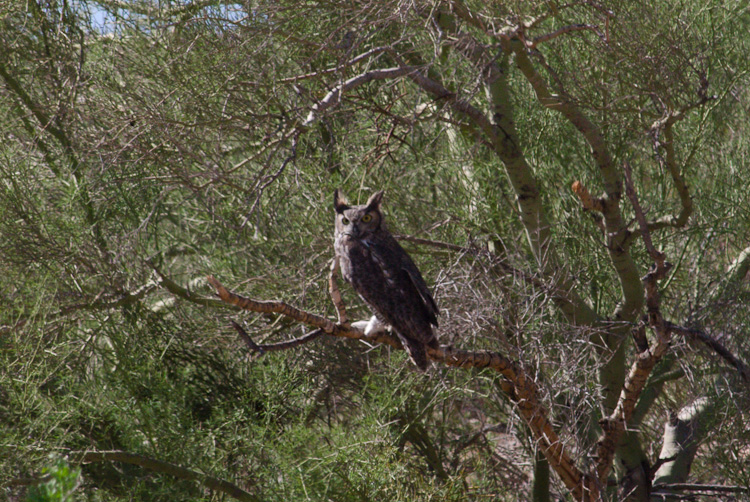
I was hiking a wash outside of Phoenix in October and spooked a large bird during the day. I immediately realized it was an owl, and was pretty excited to turn up a new owl species for me. Imagine my surprise to see it sit in a tree, and realize it appears to be a Great Horned Owl. Although extremely common in Ohio and Michigan, I have yet to ever see one. I hear them call frequently during the evenings, and I have always thought of them as a forest species. Just goes to show how little I know about the deserts and their inhabitants. Add this to my list of Ohio animals that I associate with forests, but actually see first in the desert (ex. bobcat).

BH
Sunday, November 7, 2010
Fall Amphibians in SE Ohio
From a field-herping standpoint, this fall has been a bit disappointing for me. Since returning back to the states, the last few months have flown by. I've been super busy with school and soccer. Other than a few days in August, I haven't herped at all. However, when certain weather conditions present themselves, sometimes you simply have to drop whatever you're doing to get out into the field. Last Tuesday (26 October) was one such day. I left my Mammalogy class at 5:00 PM to be greeted by a warm, heavy rainstorm. After a bit of coordination, Carl and I headed out to do a bit of roadcruising to see what amphibians we could turn up.
Our first salamander:
 Jefferson's salamander (Ambystoma jeffersonianum), a common road find in spring or fall rainstorms.
 Green frog (Lithobates clamitans).
 Spring peeper (Pseudacris crucifer). A few other peepers, American toads, and bullfrogs were observed.
 Spotted salamander (Ambystoma maculatum)
Most Ambystomatid salamanders breed during the spring. However, one interesting species found in SE Ohio defies this trend. The Marbled salamander (Ambystoma opacum) mates and lays its eggs in the fall.
 Marbled salamander (Ambystoma opacum), our target for the night. Unlike other species of this genus that lay eggs masses in vernal pools, A. opacum lay terrestrial eggs under logs or rocks, where the females remain to brood for a few weeks. During heavy fall rainfall, the eggs hatch and the larvae collect in the forming pools. Since this process occurs during the fall, the Marbled larvae presumably have a competitive advantage over other spring-born salamander larvaen. Also, they are much larger and are able to chow down on interspecific competitors.
 Another individual. After cruising for a bit, Carl and I returned to Athens met up with a new biology prof here at Ohio University, Dr. Shawn Kuchta. The three of us then headed out to another productive spot of Carl's, where we observed the following species.
 Grey treefrog (Hyla chrysoscelis/versicolor)
 Leopard frog (Lithobates pipiens). Although quite common in other parts of its range, the Leopard frog is a rarely encountered anuran in this corner of Ohio. In my 4 years living in Athens, this was the first one I've encountered (in SE Ohio).
 Another individual.
In addition to more Spotteds and Marbleds, we also saw Redbacked salamanders (Plethodon cinereus), Two-lined salamanders (Eurycea cirrigera), and Eastern newts (Notophthalmus viridescens).
Friday, November 5, 2010
Go Wings!
I have been lucky enough to make a few hockey games this year. I always try to rock my jersey of choice - Datsyuk 13. The Redwings home opener this year was one of the best games I have seen. Pavel was in rare form, recording a Gordie Howe hat trick - 1 goal, 1 assist and 1 fight. I can't say any of them were very pretty but I will never forget this night.
Pavel usually is a front runner for the Lady Bing Memorial Trophy, awarded to the "player adjudged to have exhibited the best type of sportsmanship and gentlemanly conduct combined with a high standard of playing ability". He has already won it four times, from the years 2005-2009. He might have pulled himself out of the running early this year...
Pavel usually is a front runner for the Lady Bing Memorial Trophy, awarded to the "player adjudged to have exhibited the best type of sportsmanship and gentlemanly conduct combined with a high standard of playing ability". He has already won it four times, from the years 2005-2009. He might have pulled himself out of the running early this year...
Subscribe to:
Posts (Atom)

